-
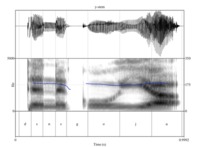 NSDy
Another example of the palatal approximant y [j], intervocalically.
-
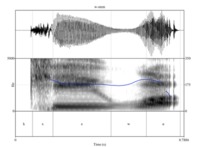 NSDw
The voiced labio-velar approximant w [w] intervocalically. Note the velar affricate k [kx] in word-initial position.
-
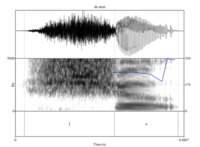 NSDuH
-
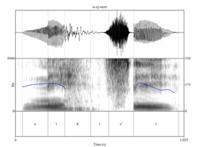 NSDts-
The alveolar ejective affricate ts’ [ts’] in stem-initial position, following h [h] in the coda of the previous syllable. Note the compression of the closure portion of the affricate and the duration of release. Also note the characteristic ejective pattern; there is a period of silence before the glottal release into the vowel.
-
 NSDt
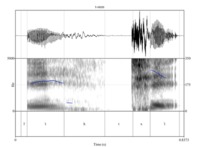
This example of t [tx] is in stem-initial and word-medial position, following the glottal fricative h [h]. The closure and release periods of the t [tx] can be seen clearly in this example. The velar fricative offglide is an audible property of this sound.
-
 NSDtl
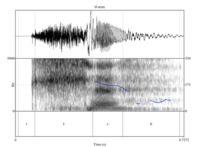
A word-initial example of the aspirated lateral affricate tł [tɬʰ] with a very long and strong fricative release.
-
 NSDt-
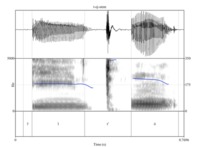
Another example of the alveolar ejective stop t’ [t’] in stem-initial position, between two vowels. This example shows the characteristic ejective profile, with the release of the stop visible halfway through the sound.
-
 NSDsh
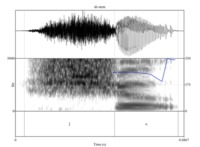
Another example of the voiceless post-alveolar fricative sh [ʃ] in word-initial position. This word was spoken in isolation. The initial consonant is quite long, but this gives a good idea of how strongly fricatives are articulated in the Dene languages as compared to European languages such as English.
-
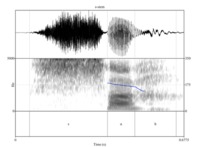 NSDs
Another example of the voiceless alveolar fricative s [s] in word-initial position.
-
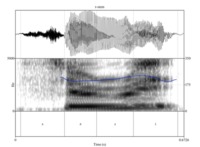 NSDr
Contrast this example with the previous one. In this example, the r [ɹ] is intervocalic and strongly voiced. The characteristic dip of the third formant found in rhotic appproximants is visible in the spectrogram.
-
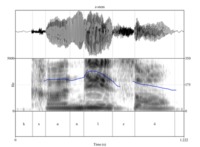 NSDoNH
Note that the high tone on the final syllable is lower than the high tone on the second syllable.
-
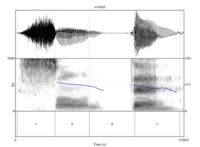 NSDoN
-
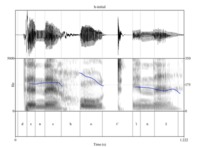 NSDoF
The mid back vowel o [o], long and with falling tone.
-
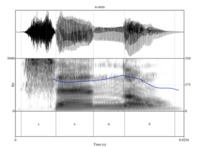 NSDn
The alveolar nasal between two vowels. Note the falling tone on the vowel in the final syllable; compare with the falling tone on a medial vowel in this example.
-
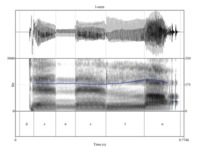 NSDl
Another instance of the voiced lateral approximant, this time word-medially but in stem-initial position.
-
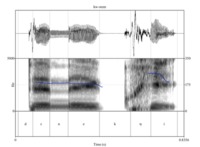 NSDkw
The voiceless labialized velar stop kw [kw̥] in stem-initial position. Like the plain velar stop k [kx], this stop has affricate-like properties.
-
 NSDkw-
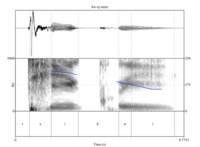
This is an interesting example of this sound. This sound is a variation on kw’ [kw̥’], but is articulated differently from the other ejective affricates. It is a velar ejective [k’] followed by a labial glide [w], as opposed to the labialized velar ejective [kw̥’] found in the preceding example. Note the characteristic ejective pattern in the waveform and spectrogram.
-
 NSDk
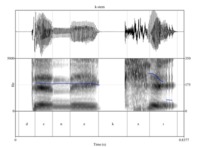
Another example of the velar affricate k [kx], in stem-initial position.
-
 NSDk-
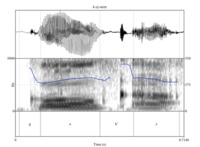
The velar ejective k’ [k’] in stem-initial position. The characteristic ejective pattern is visible in the waveform and the spectrogram.
-
 NSDj
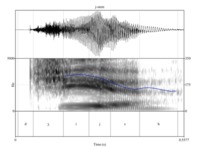
Another example of j [tʃ] in word-initial position, also voiceless. Note the way the fricative portion of the stop transitions into the vowel without any aspiration; contrast this with the aspiration of ch [tʃʰ].
-
 NSDlh
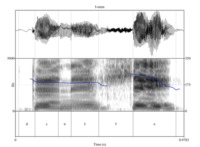
The voiceless lateral fricative ł [ɬ] in stem-initial position between two vowels. Note that the voicing of the vowel extends into the first part of the fricative.
-
 NSDi
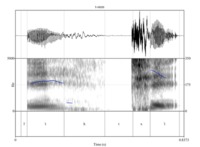
The high front vowel nasalized and with high tone.
-
 NSDi
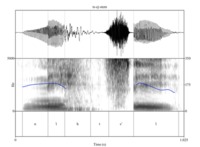
A token with two instances of the high front vowel nasalized and with low tone. Note also the compression of the closure period of the ejective affricate ts’ [ts’] in stem-initial position following a closed syllable.
-
 NSDg
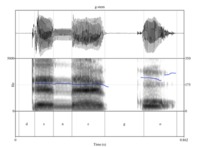
The unaspirated velar stop g [k] in stem-initial position, between two vowels. This is the position that would be most likely to show voicing if unaspirated stops were voiced; the lack of voicing in this position shows that the unaspirated stops of this dialect of North Slavey are voiceless sounds.
-
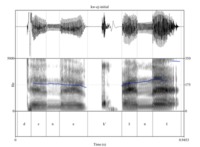 NSDeN
This example contains all short variants of the mid front vowel. All but one of these vowels are transcribed [ɛ], which is a lower variant of [e].
-
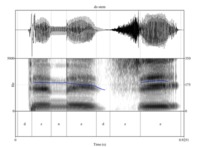 NSDdz
The unaspirated alveolar affricate dz [ts] in stem-initial, intervocalic position. The plosive closure portion of the affricate in this example is voiced. The fricative releases directly into the vowel with any period of aspiration.
-
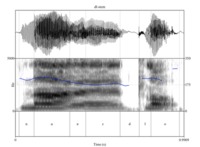 NSDdl
The unaspirated lateral affricate dl [tɬ] in stem-initial position. Note also the rhotic r, which is realized here as a well articulated central approximant [???].
-
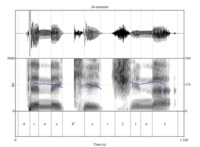 NSDch
Another example of the post-alveolar affricate ch [tʃʰ] between two vowels. This is also aspirated, which is visible in the transition of the fricative portion of the affricate into the vowel. Note also the k [kx], with its velar fricative release.
-
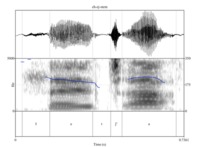 NSDch-
The post-alveolar ejective affricate ch’ [tʃ'] in stem-initial position between two vowels. The characteristic ejective pattern is less obvious here, and the sound is perceived as an aspirated affricate, instead of an ejective.
-
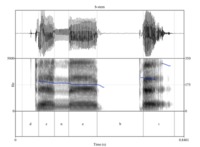 NSDb
The unaspirated bilabial stop b [p] in stem-initial position between two vowels. The sound is clearly voiceless in this example, as well.
-
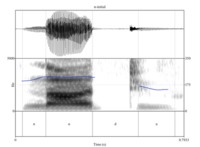 NSDaH
Note the intervocalic d [t], both for its duration and its voicelessness; compare this with the voicelessness of the other unaspirated stops b [p] and g [k].
-
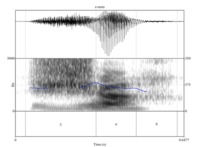 NSDzh
A fully voiced post-alveolar fricative zh [ʒ]. Full voicing in an obstruent in North Slavey, as we see here, is not common.
-
 NSDz
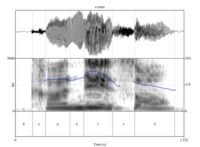
The voiced alveolar fricative z [z] in stem-initial position. The fricative is voiced only through the first part of the sound. Note the initial k [kx].
-
 NSDy
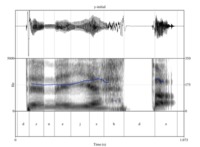
The palatal approximant y [j] intervocalically. Note also the two instances of d [t] in this example; both are voiceless. The length of the stem-initial d [t] in the final syllable is characteristic for stem-initial consonants.
-
 NSDwh
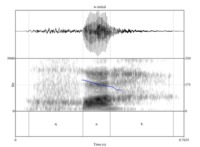
The voiceless labiovelar approximant wh [w̥]; contrast this sound with its voiced counterpart w [w].
-
 NSDw
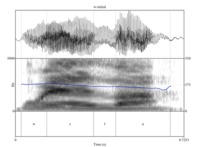
The voiced labio-velar approximant w [w] in word-initial position.
-
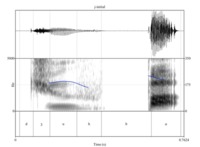 NSDu
-
 NSDts
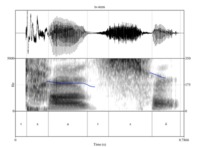
A good example of a Dene aspirated affricate. The aspiration appears at the end of the fricative part of the sound as it transitions into the vowel. This aspiration is clearly visible in the waveform and spectrogram. Contrast the aspirated release of this sound with its unaspirated counterpart dz [ts]. Observe also the compression of the closure period of the affricate; it is partially voiced and is quite short.
-
 NSDts-
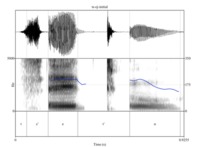
A word with two ejectives ts’ [ts’] and t’ [t’]. Both show the characteristic ejective pattern. In this example, ts’ [ts’] is in word-initial position; t’ [t’] is in stem-initial position.
-
 NSDt
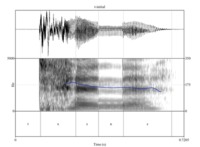
This token of t [tx] exemplifies the sound as an alveolar stop followed by velar fricative. The velar fricative release is a distinctive property of this sound, and makes the sound quite unlike the English aspirated stop [tʰ]. The t [tx] shown here is in word-initial position.
-
 NSDtl-
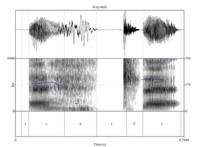
An example of the lateral ejective affricate, in stem-initial and word medial-position followed by a glottal fricative. The boundary between these two segments is a major juncture in the word, a domain break between the stem and the pre-stem domains.
-
 NSDtl
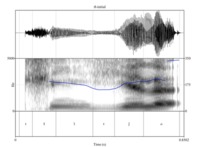
The aspirated lateral affricate tł [tɬʰ] in word-initial position. This sound is voiceless; the transition of the fricative portion into the vowel is a characteristic property of aspirated affricates. The lateral is a fricative; contrast this with the lateral approximant of the dl [dl].
-
 NSDt-
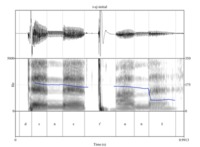
The alveolar ejective t’ [t’] in stem-initial position between two vowels. This as a characteristic example of the Dene ejective stop, with the release of the stop about halfway through the sound. Dene ejectives are voiceless, as ejectives commonly are.
-
 NSDsh
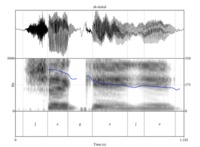
The voiceless post-alveolar fricative sh [ʃ] in word-initial position.
-
 NSDs
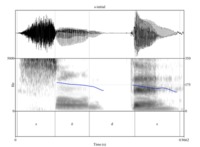
The voiceless alveolar fricative s [s] in word-initial position. Note also the partially voiced d [t].
-
 NSDr
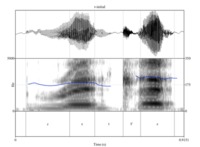
The voiced alveolar rhotic r [ɹ] in word-initial position.
-
 NSDo
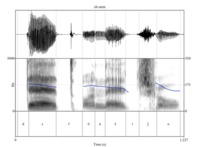
An example containing two instances of the mid back vowel o [o]; the first instance of o [o], following the alveolar ejective t’ [t’], is nasalized.
-
 NSDn
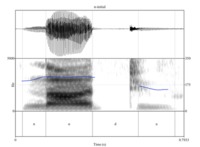
An example of the alveolar nasal n [n] in word-initial position.
-
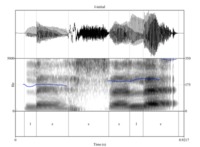 NSDl
An example of the voiced lateral approximant l [l]. Though this sound is classified as a fricative in the phoneme inventory, it appears twice in this word as an approximant.
-
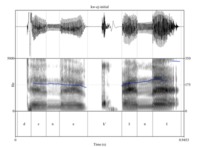 NSDkw-
The labialized velar ejective kw’ [kw̥’] in stem-initial position.
-
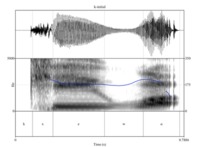 NSDk
The velar affricate k [kx] word-initially. This sound has been described as an aspirated plain stop, but it has the profile of an affricate. Its release is strongly fricated; this is an visible and audible property of the sound.
-
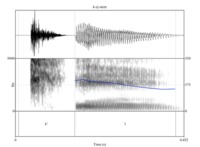 NSDk-
The velar ejective k’ [k’] in word-initial position, showing the characteristic ejective pattern. Compare this example to examples of other ejectives t’ [t’], ts’ [ts’], and ch’ [tʃ’], as well as the following example of k’ [k’] in word-medial position.
-
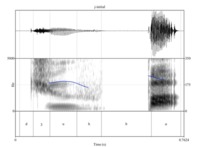 NSDj
The unaspirated post-alveolar affricate j [tʃ] in word-initial position, here voiceless. Note also the duration of the stem-initial unaspirated bilabial stop b [b].
-
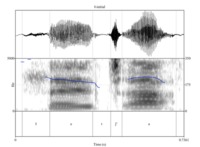 NSDlh
The voiceless lateral fricative ł [ɬ] in word-initial position. Note also the post-alveolar ejective affricate ch’ [tʃ’]; in this example, this sounds does not show the characteristic ejective pattern, and may be perceptually an aspirated affricate ch [tʃʱ] instead.
-
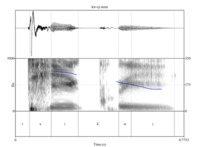 NSDi
Examples of the high front vowel i [i~ɪ] with high tone (first syllable) and low tone (second syllable).
-
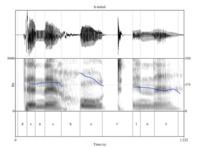 NSDh
The glottal fricative h [h]. Note the falling tone on the long vowel following the glottal fricative, in contrast to the comparatively flat tone of the other syllables.
-
 NSDgh
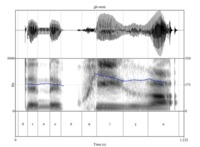
The intervocalic voiced velar fricative gh [ɣ], articulated here as an approximant. There is little energy in the higher frequencies, and clear formant structure. Compare this with n [n] is this example, which is also an approximant.
-
 NSDg
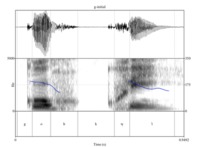
The voiceless velar stop g [k] in word-initial position; it is voiceless. Other unaspirated stops in the language also tend to be voiceless; see b [p] and d [t].
-
 NSDe
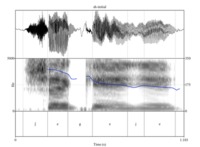
An example with three instances of e [e~ɛ]; the first carries high tone, while the second two carry low tone. The mid front vowel is the most common vowel in the dataset, and is also the most common prefix vowel, as well as being the most dispersed vowel in the vowel space.
-
 NSDdz
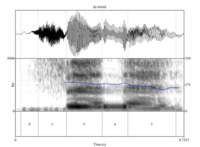
The voiceless alveolar affricate dz [ts] in word-initial position. It differs from the aspirated version ts [tsʰ] in the duration of its release and in its movement directly into a vowel without an aspiration period.
-
 NSDdl
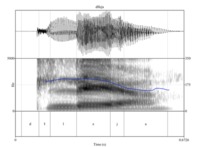
The unaspirated lateral affricate dl [tɬ] with a partially voiced release. Note that the release portion begins as a voiced fricative, but then transitions to an approximant. The transition is clearly visible in the waveform and spectrogram.
-
 NSDd
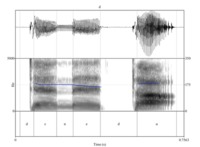
The unaspirated alveolar stop d [t] in word-initial and stem-initial position. In both occurrences, the stop is voiceless, and the following vowel beings immediately after the stop release.
-
 NSDch
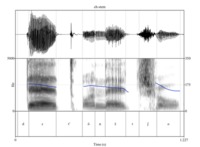
The aspirated post-alveolar affricate ch [tʃʰ] in stem-initial position between two vowels. Contrast the transition of the fricative release into the vowel with the fricative release of the unaspirated version j [tʃ]. This token also contains an example of an ejective t’ [t’], with the characteristic ejective pattern.
-
 NSDch-
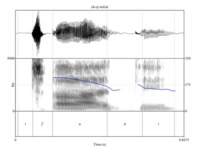
The post-alveolar ejective affricate ch’ [tʃ'] in word-initial position, showing the characteristic Dene ejective pattern.
-
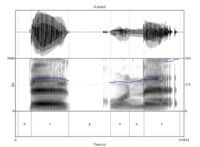 NSDb
The unaspirated bilabial stop b [p] in word initial-position. This sound is voiceless; note also the voicelessness of the stem-initial stop g [k].
-
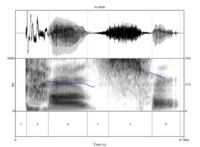 NSDa
The low back vowel a [ɑ] with low tone. Note the initial t [tx], with strong velar frication in the release, and the compression of the closure portion of the affricate in the medial ts [tsʰ].
