kw’ [kw’]
Voiceless Labio-velar Ejective
Tłį Chǫ (Dogrib), Behchokǫ̀
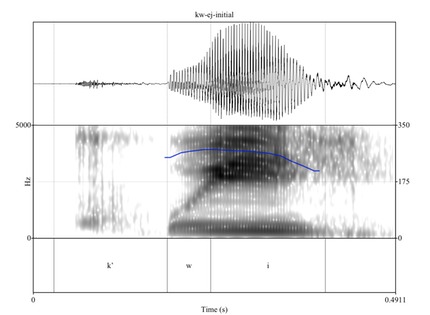
1. kw’i [k’wi] "mosquito" - Speaker: SP2
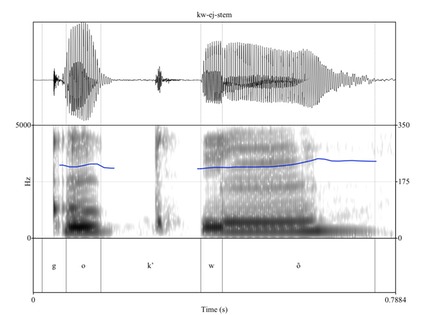
In both examples on this page, this sound is articulated as a velar ejective [k’] followed by a labio-velar glide [w]; that is, as the sequence [k’w] rather than as a labialized velar ejective [kw’]. The glide portion of this sound is voiced, and its formant structure (dark energy bands) is visible. Note the movement of the second formant is as it rises during the sound.
2018-07-20
2. gokw’ǫǫ̀ [gok’wõ̀ː] "bone" - Speaker: SP3
An intervocalic example of kw’, which is realized in these examples as a characteristic velar ejective [k’] followed by a labio-velar glide [w]. In this example, the labio-velar glide clearly follows the ejective k’ [k’w]. Note also that the velar stop g [g] in initial position is voiceless.
2018-07-20