t’ [t’]
Alveolar Ejective
Tłį Chǫ (Dogrib), Behchokǫ̀
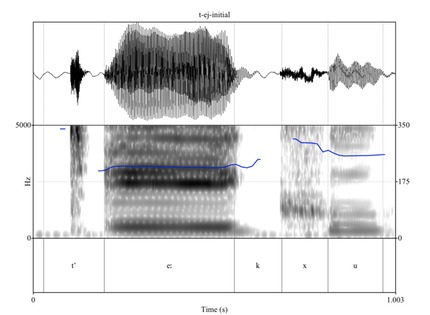
1. t’eeko [t’eːkxu] "young woman" - Speaker: SP4
The alveolar ejective t’ [t’] in word-initial position. In this example, the oral release can be seen in the dark thick band of energy of the release burst, which is followed by a period of silence before the onset of the vowel. This "silence" is caused by a delay in the release of the glottal gesture of the ejective. The vowel begins at the glottal release, but the alveolar closure of the stop is released halfway through. This is called known as a "strong" ejective.
2018-07-24
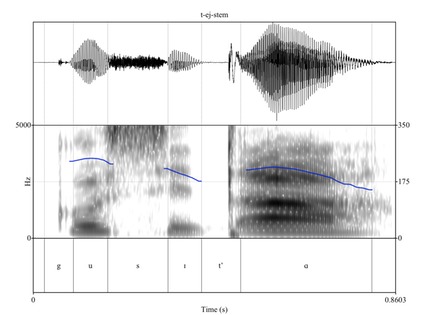
2. gotsį̀ht’a [kusɪt’ɑ] "back" - Speaker: SP2
The ejective t’ [t’] in word-medial position. This is an example of a "weak" ejective. Unlike the characteristic t’ [t’] sound, in this example, the glottal release of the t’ [t’] ejective comes closely after its oral release, the release burst is followed closely by the onset of the vowel. This sound may be perceived as a voiced alveolar stop d [d].
2018-07-24